Services
Everything starts with knowing what AI you have. The inventory shows which of the next steps apply to you.
AI inventory and classification
- Every AI feature found and classified, with the reasoning
- Your role (provider or deployer), your obligations and deadlines
- A gap report, all in your AI register
Art. 50 check
- Which features must disclose that they are AI or mark their output
- Draft notices and marking requirements
- A transparency pack per product
Build, Document, Attest
- Build: risk, data and system design
- Document: technical documentation and quality
- Attest: conformity, registration and post-market monitoring
Deployer duties
- Human oversight, logs, and informing staff and the people affected
- AI literacy for your teams
- A fundamental rights impact assessment (FRIA), where required
After the inventory, we keep your register up to date as your features, your models and the official guidance change.
Register
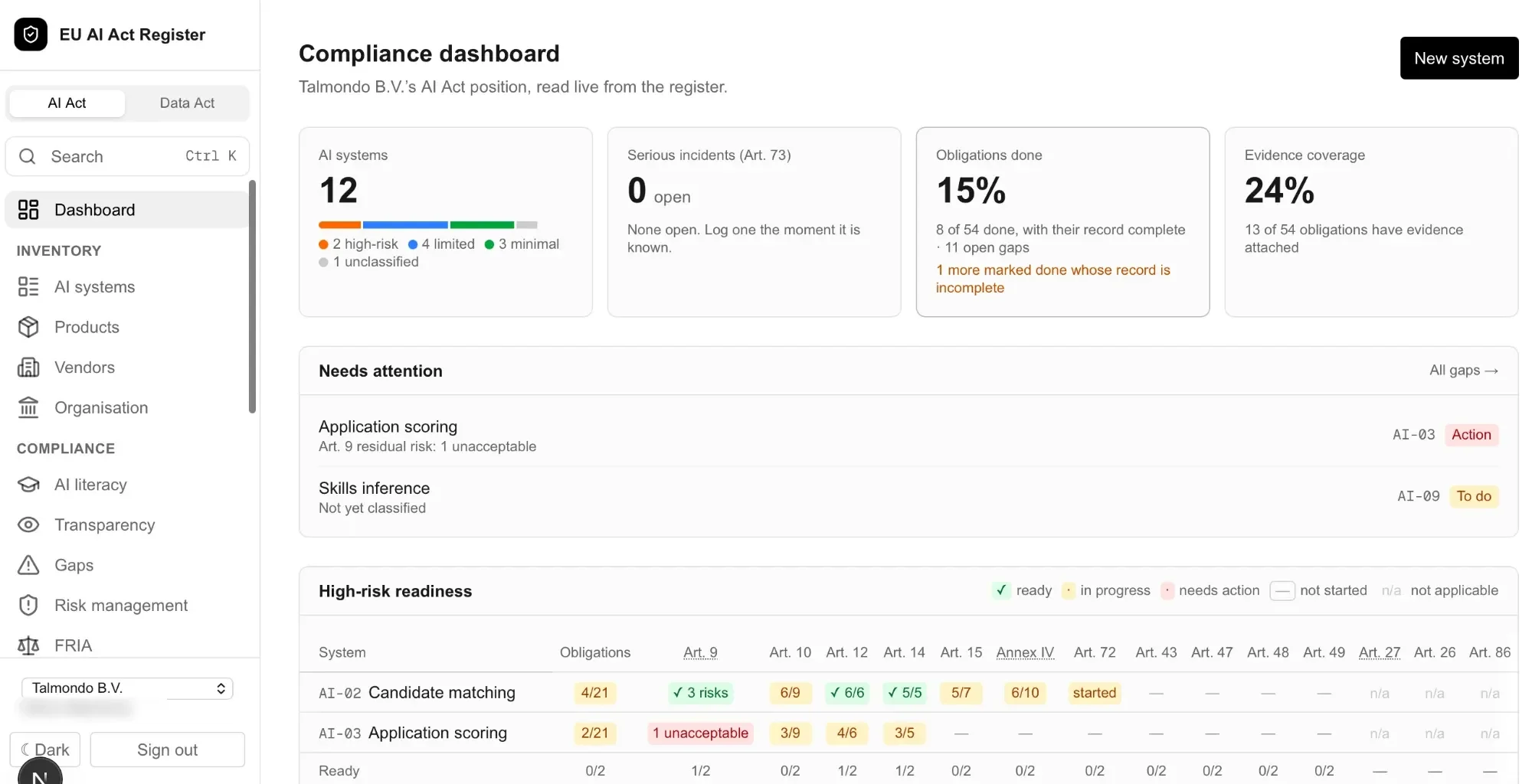
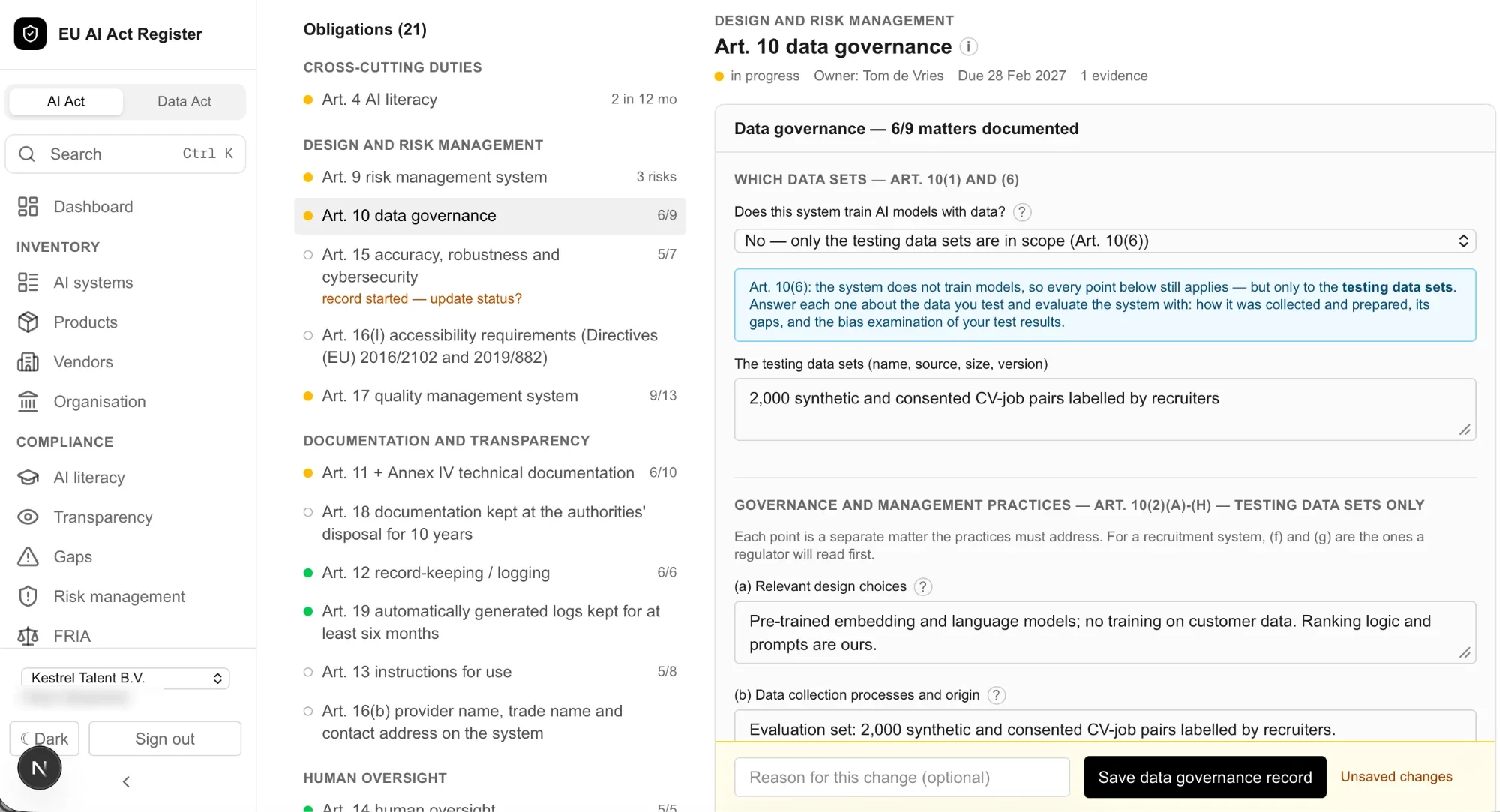
Everything we do is recorded in your AI register, an application we build and host ourselves. Your team can view and export it at any time.
Your AI inventory. Each AI system or feature with its product, model and supplier, where it runs, and how it connects to your other systems.
Classification with reasoning. Risk level, role and Art. 50 duties for each system, with the reasoning, the legal basis and who made the decision.
Obligations and deadlines. Derived from the AI Act for each system, with the date each one applies, and updated when the law or your product changes.
Evidence. The documents and links that show each obligation is met.
History and frozen versions. Every change is logged: who made it, when and why. Approved versions are frozen for auditors and customers.
Documents generated from the register. Technical documentation, instructions for use, transparency pack, FRIA and EU declaration of conformity.
Exports. Excel, JSON and PDF, whenever your team needs them.
How we work
We need to understand your AI features. We don't need to read your code or your data.
- 01
Your team runs our review prompt
Using its own AI coding assistant, in its own repository. The prompt tells the assistant to read only: no file changes, no commands, no downloads. (The assistant still communicates with its own provider, under your usual policy.)
- 02
You read the result
The output is a written description of each AI feature, with no code, file names or secrets. You read it and remove anything you'd rather not share.
- 03
We classify each feature in your register
If a description isn't enough, we come back to you with questions.
AI drafts, consultants decide
Every classification, finding and recommendation is reviewed and signed off by a consultant, and the register records who decided what.
Documentation, not personal data
We work from prompts, product descriptions, policies and contracts. We never need CVs, customer records or credentials.
Your choice
If you prefer, we keep your documents out of AI tools entirely and analyse them by hand.
Roadmap
Unacceptable AI practices banned
AI practices classed as an “unacceptable risk” are prohibited, and the AI literacy obligation starts to apply to organisations.
GPAI rules and governance apply
The rules for general-purpose AI (GPAI) models, the governance structure including the AI Office, and the penalty regime start to apply across the EU.
Transparency obligations (Art. 50)
The transparency rules for chatbots, AI-generated content, deepfakes and emotion recognition start to apply.
Synthetic content marking
Systems placed on the market before 2 August 2026 must now mark the content they generate, and apps that create non-consensual intimate images (“nudifiers”) are prohibited.
High-risk AI obligations (Annex III)
The core requirements for high-risk AI systems start to apply: recruitment, credit scoring, law enforcement, biometrics, education, critical infrastructure. The AI Omnibus moved this date from August 2026.
High-risk AI in regulated products (Annex I)
High-risk AI built into products covered by EU product safety legislation must comply in full: medical devices, machinery, vehicles, aviation and more.
FAQ
What is the EU AI Act?+
The EU AI Act (Regulation (EU) 2024/1689) is the first comprehensive law on artificial intelligence. It entered into force on 1 August 2024. It applies to any organisation that places AI systems on the EU market or whose AI systems are used in the EU, wherever the organisation is based.
When do EU AI Act obligations start?+
The obligations apply in stages. 2 February 2025: bans on prohibited AI practices, and AI literacy. 2 August 2025: rules for general-purpose AI (GPAI) models, and governance. 2 August 2026: the Article 50 transparency obligations (chatbots, AI-generated content, deepfakes, emotion recognition). 2 December 2026: marking of AI-generated content by systems already on the market before August 2026. 2 December 2027: high-risk AI systems listed in Annex III (recruitment, credit scoring, education, essential services). 2 August 2028: high-risk AI in regulated products (Annex I, for example medical devices and machinery).
Which AI systems are considered high-risk under the EU AI Act?+
The high-risk uses are listed in Annex III of the AI Act. They include AI used for recruitment and HR decisions, credit scoring and access to essential services, assessment in education, law enforcement and justice, migration and border control, critical infrastructure, and remote biometric identification. These systems must meet strict requirements for risk management, data governance, documentation, human oversight and transparency before they are placed on the market.
Does the EU AI Act apply to SMEs?+
Yes. The AI Act applies to any organisation, including SMEs and start-ups, that develops or uses AI systems affecting people in the EU. It does make some allowances for SMEs: a simplified form of technical documentation, priority access to regulatory sandboxes, and lower fine caps. But if your AI system is high-risk, the full requirements apply whatever the size of your company.
What happens if a company does not comply with the EU AI Act?+
Fines depend on the breach: up to €35 million or 7% of worldwide annual turnover for prohibited AI practices; up to €15 million or 3% for most other breaches, such as failing to meet the high-risk requirements or the transparency duties; up to €7.5 million or 1% for supplying incorrect information to the authorities. For SMEs and start-ups, the lower of the two amounts applies.
Where do I start with EU AI Act compliance?+
Start with an inventory of every AI system your organisation builds or uses, and classify each one: prohibited, high-risk, subject to transparency duties, or minimal risk, and whether you are its provider or its deployer. That tells you which obligations apply and by when. Our free checker at app.euai-compliance.com classifies one system in about 10 minutes; our AI inventory and classification service covers all of them, with the reasoning, in your own AI register.
Blog
Practical EU AI Act guides and deadline updates
EU AI Act Enforcement Began August 2026 — And It Wasn't About High-Risk Systems
The Act's first live enforcement date targeted chatbot and deepfake disclosure, not risk classification. Here's why that catches most compliance plans off guard.
Read article →EU AI Act Annex III: The 8 High-Risk Areas Explained (2026)
The eight Annex III high-risk areas of the EU AI Act, with real-world examples, the Article 6(3) exception, the obligations that apply and the December 2027 deadline.
Read article →EU AI Act Compliance Checklist for SMEs: 7 Steps to Get Ready
A practical step-by-step checklist to assess your exposure and build a compliance plan.
Read article →Contact
Book a call or send a message about your AI features.
Whether you have a defined project or just a feeling that the AI Act should be on your agenda, a first conversation costs nothing and usually clarifies a lot.